Acerca de

Academic Writing
This page displays my progress over the course of Writing 39C and my process in creating my final Literature Review and Advocacy Project. I include some of the building blocks that led to the final draft of my essay, talk about my experiences with peer reviewing, before and afters of my essay, and a link to the final draft with the full text. This page also includes screenshots of my work with curation to describe the screenshots and what you're looking at!
Three Building Blocks
1

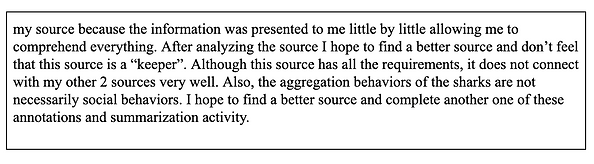
One important building block that was really beneficial in completing my Literature Review and Advocacy Project was the Big 3 Annotations assignment that we completed with the initial three research studies we found on our species. This was helpful in testing whether or not the sources we chose would be good fits in our essay. As you can see by this excerpt from the assignment, I ended up fining a new source because after analyzing it I felt that the source did not really connect or fit with my other sources.
2

Another important building block were the Twitter updates we made to our accounts, specifically the 10 tweets we had to tweet about our species. This was really helpful in getting to know a little bit more about my species and finding some good sources that I could use in my writing. Above is a tweet I made for this assignment about how sharks have many teeth, something I didn't know before!
3

The third important building block was the Connect assignment called "Brief Review: Introductions, Conclusions, and MLA Format. This was really helpful because I needed a review on MLA citation. I had not used proper MLA in a decent amount of time, which was apparent through my "Most Challenging Concepts" being MLA.
Peer Review
Peer review is an important practice that allows you to receive feedback on your writing and give feedback to others on their writing. While giving feedback, you are also able to learn about effective strategies that you could use to improve your own writing that you didn’t think about before. Throughout the course of this class, I have learned that peer review can be really helpful to you as a writer. Especially when composing a longer piece, you can easily miss important aspects that you should have added or could better expand upon. However, a new set of eyes can help you understand what you can do to make your writing better. Peer review has definitely been a helpful experience for me and I have learned to value this experience.
There have been times where I thought my Literature Review was clear to readers and didn’t need a larger explanation, but peer reviewers commented about their confusion. Oftentimes when you write about something you’ve researched for so long, you are not sure what is understandable to the general public and what needs more explanation. I had both good and bad experiences from peer reviewing, but mostly on the better side. Some downsides I faced during peer review was reviewing the work of classmates that very obviously strayed from the instructions. I wanted to provide the best feedback possible, but it was sometimes tricky when the piece I had to review was half completed or didn’t have the components we were looking for.
I think I got many good ideas for my own writing through the peer review process. I was able to experience different writing styles and various examples of how to execute the same prompt. I also think this process helped me with my reading skills because I was introduced to various reading materials and practiced searching for certain components, such as a thesis, analyses, and good source usage, in a longer piece of writing.
Good Advice I Gave

This is one of my best pieces of advice from the Literature Review assignment. The advice is about including more transition sentences into the piece. I think this is my best piece of advice because it is really detailed and lets the writer know exactly what can be done to improve the writing.
Poor Advice I Gave
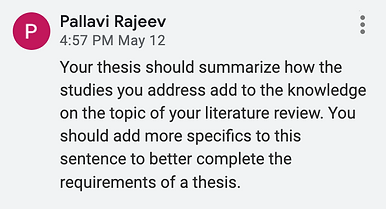
This is one of my poorest pieces of advice from the Literature Review assignment. This advice is about editing the thesis of the essay and adding more details to the thesis. I think this is not one of my best pieces of advice because there is a lack of detail in explaining exactly the steps the writer could take to make their piece better.
Best Advice Received from Weeks 1-5
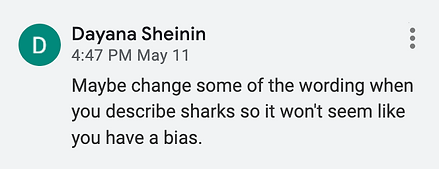
This is one of the best pieces of advice I received on my Literature Review from weeks 1-5. The advice is about taking out some of the biased word choice in my essay. This is one of the best pieces of advice I received because this is something I didn't notice I was doing.
Best Advice Received from Weeks 6-10

This is one of the best pieces of advice I received on my Literature Review and Advocacy Project from weeks 6-10. The advice is about adding more separation between the two parts of my essay and possibly including headers to make everything more clear. This is another one of the best pieces of advice I received because I did not know that I was "detracting" from my main argument and this helped me ensure my argument was strong, clear, and independent.
The Review and Revision Process
1
Before

After

MLA format is one of the minimum requirements for the Advocacy Project. One change I made to my essay was fixing the MLA formatting; for example, I didn't previously add page numbers to my quotes but added them in to my final draft.
2
Before

After

Academic Ethos is another one of the minimum requirements. One change I made to my essay was ensuring that I maintained an objective tone overall. I had some places where I expressed bias towards my species due to my word choice, and I edited those out as depicted above.
3
Before

After

Clarity, Sentence Structure, and Readability is a minimum requirement of the Advocacy Project. One change I made was cutting down on some of the unnecessary elements and wordiness of my essay. In this specific example, I felt that it was no longer necessary to explain the focus of the essay, since that is something I initially wrote for my Literature Review.